

Halloween’s here again. We used to carve pumpkins too when I was a kid. It’s not hard to guess that this was back in the Kádár era, when we were happily building socialism behind the Iron Curtain and could only travel to the West once every three years. Western culture hadn’t made it in here yet: we didn’t have the faintest idea what Halloween was. But pumpkins grew here all the same.
The Halloween pumpkin
We didn’t carve the big orange pumpkins that are fashionable today, either. We used ordinary field pumpkins (Cucurbita pepo, green or yellowish-green, sometimes faintly striped) or greenish-white giant squash (Cucurbita maxima, the “gyalulótök”). But we carved jack-o’-lanterns, and we could say of them: a bit small, a bit green, but they’re ours! – like the lemon in Péter Bacsó’s film The Witness, Oh, and we didn’t carve them on All Saints’ Day but at harvest time, in late September or early October. By All Saints’ there was sometimes snow on the ground already, and nobody fancied whittling pumpkins out in the yard.
The big yellow pumpkins in fashion these days are either field pumpkins bred into eating varieties (C. pepo var. pepo), sold under various fancy names (e.g. Jack-o’-Lantern), or ornamental pumpkins grown specifically for this purpose (Gomez F1, Cronus F1, Yellowboys F1). It’s worth knowing that ornamental pumpkins aren’t fit to eat: they’re tasteless, and some of them can even be poisonous! After Halloween, a post goes round social media every so often: “Don’t throw it away, give it to cute hungry animals!” Don’t! Wild boar will eat it, sure, just as domestic pigs eat field pumpkins, but plenty of other animals can get sick from it. A jack-o’-lantern can contain toxic residue from the tealight, paint, resin, bits of metal and so on, and the ornamental pumpkin itself may be poisonous as well. So the truly eco-conscious person puts it where it belongs: in the bin, or, once cleaned, on the compost heap.
If you really want a jack-o’-lantern you can eat afterwards, use an eating pumpkin and an electric tealight. Perfectly clean, cooked or roasted eating pumpkin can even be given to the dog in small amounts, but Halloween ornamental pumpkins aren’t like that!

Put electric lighting in your pumpkin!
As for electric lighting, it’s a good idea for several reasons: it doesn’t contaminate the pumpkin, it doesn’t start fires, it won’t burn the house down, and the wind can’t blow it out. Just don’t throw the used tealight and the batteries in the general waste bin afterwards!
Incidentally, the amber LED that imitates flickering candlelight contains surprisingly complex electronics. Maybe I’ll write about that some time; for now, suffice it to say it’s not your run-of-the-mill LED. When we carved jack-o’-lanterns as kids, tealights like that didn’t exist yet. Red LEDs had been around for a long time, while yellow and then green ones were only just appearing. Blue LEDs didn’t exist yet; they hadn’t been invented. So no white ones either. And of course the LEDs of the day gave off pretty feeble light: they worked fine on a display panel, an instrument front panel or a lift’s floor indicator, but they couldn’t have lit up even a single pumpkin. High-brightness LEDs didn’t exist.
There were 0.25 W torch bulbs, of course, plus Perion flat batteries and D cells. You could have lit a pumpkin with those, if the batteries hadn’t been so huge and hadn’t run down so fast. It worked in a torch used for short stretches, but a jack-o’-lantern burning all night would have devoured batteries. A tealight or a candle was simpler and much cheaper.
So yes, we had a hard childhood, living in dire poverty in the years of socialism: we had neither yellow Halloween pumpkins nor coloured LED tealights. Nor had we been “sensitised” to our fellow human beings with disabilities. Mari (Hungarian: Mári) could tell you all about that, if she were still alive and if she could speak coherently.
Mari Czaun
Mari Czaun couldn’t really speak coherently. She was a bit simple-minded and had a speech impediment. She could probably read, though, because she subscribed to the Veszprém Napló. She always had a copy folded up in her pocket. Maybe she only used it as a fly swatter, but she may well have read it too. People read in those days. Even Lakić, the Serbian shepherd, did, and the only person in the area lower on the social ladder than him would have been the village swineherd, except there wasn’t swineherd. There were pigs, though: the Lakić family slaughtered two pig a year and always respectfully sent my grandfather a taste. My grandmother would cook tasters like that through thoroughly and give them to the dogs. But not the Lakićes’. That one went straight into the carcass pit, wrapped in a copy of Napló. Nobody considered the Serbian shepherd’s family clean enough… Whether that was simply racism, I couldn’t say. We didn’t play with the Lakić kids.
In many respects, though, the community was tolerant. Mari found her place and her role, too: she was the night watchman at the state farm. She didn’t have a pig, so she never sent anyone a taster. She just had a puli-type dog, and the two of them lived together. Mari wasn’t just simple-minded and speech-impaired; she was also, shall we say, an intersex specimen — though back then, we had no idea what ‘intersex’ even meant. I don’t think anyone round there did, least of all Mari. All she knew was that she felt comfortable in men’s clothing. She always wore men’s clothes, a beret, and carried a carved shepherd’s crook. She had a bit of a moustache, too…
Mari was the constant target of the local kids’ pranks. We’d try to scare her with all sorts of things. The crowning glory was when somebody had the idea of hanging two rubber boots from a beam in the horse stable so they’d dangle at roughly Mari’s head height (not difficult, as she was on the short side). That night in the dark, Mari walked right into them, just as planned. What came next was not planned. She felt them over, and it slowly dawned on her that they were two boots. She took off running the length of the street in the middle of the night, screeching:
“Muramista, muramista! Pista Mürkli’s gone ’n’ ‘ung ‘isself! Pista’s dead!”
(‘Muramista’ is a garbled, dialectal slurring of the Hungarian exclamation ‘Uramisten!’ Literally ‘Lord God!’ or ‘Oh my God!’)
What made Mari a good night watchman was that she could screech brilliantly, which was very useful if, say, a haystack caught fire at night (it happened; damp straw is prone to spontaneous combustion!). This time, though, the screeching was entirely unnecessary, but Mari panicked terribly. They say she was brought back the next morning from the neighbouring village, where she’d been found trembling in the church doorway.
Why she picked poor old Uncle Mürkli of all people remains a mystery. She stubbornly insisted he was dead, so from then on she avoided the old man. Uncle Mürkli had been sleeping the sleep on this night and only learned in the village shop the next morning that he’d “gone ’n’ died”. The “hung himself” idea was so firmly lodged in Mari’s head that even Uncle Mürkli’s wife, Aunt Annus, couldn’t convince her the man was alive. Back then we’d never heard of anything like imprinting, and we didn’t know that what we were doing was abuse, so we thought the whole thing was hilarious.
To this day nobody knows whose idea it was. I couldn’t tell you if my life depended on it. Only years later did my grandmother remember that my grandfather had had a pair of old, disused rubber boots somewhere, which went missing around that time…
You could also try scaring Mari with glowing pumpkin heads, but they never really frightened her; she only went through the motions. Who knows what went through her mind at those times. Maybe it was like a village dog that dutifully barks at everyone who walks past the gate but is actually bored stiff by the whole business. If the kids put a pumpkin on a fence post and Mari walked by, she’d wail a bit, leaning on her crook, and then trudge off with her dog.
The ghost-sound effect
A candle in a pumpkin? I mean, seriously, how would that look? Our socialism under construction had already electrified even the remotest farmsteads, and here’s a young radio ham fumbling about with candles? The order went out: ‘Comrades, what we need here is an electric pumpkin!’ And if an electric pumpkin is needed, the radio-ham Young Pioneer doesn’t dither — he electrifies.
First he gets hold of the twin-lead cable from the TV aerial of Lajos Simon, the local drunk. That one, because it was nice and long, and Lajos Simon didn’t need it. For one thing, he hardly ever watched TV, because by the time the evening programmes started he’d already be drunk and passed out somewhere. For another, the poor devil had died two years earlier. The drink got him. He went down to the cellar for more booze, the ladder broke under him, he hit his head, and they found him three days later. Nobody had gone looking for him till then…
With the twin-lead, the pumpkin could be powered remotely. On top of that, the green-painted light bulb could be switched on and off and its brightness adjusted with a pot. And once you’ve got electricity in the pumpkin, you can make it produce sound as well. The shrieking, wailing “ghost sound” was generated electronically. The original circuit and the finished board were lost long ago. I’ve now tried to reconstruct it.
Surprisingly, I didn’t find many interesting or decent-looking solutions online. On 17 August 2025, Ian Burkard posted photos of an old module in the PCB DESIGNERS group on Facebook. It was built around NE555 and CD4049 ICs. There’s no schematic, and no information on what kind of sound it makes.
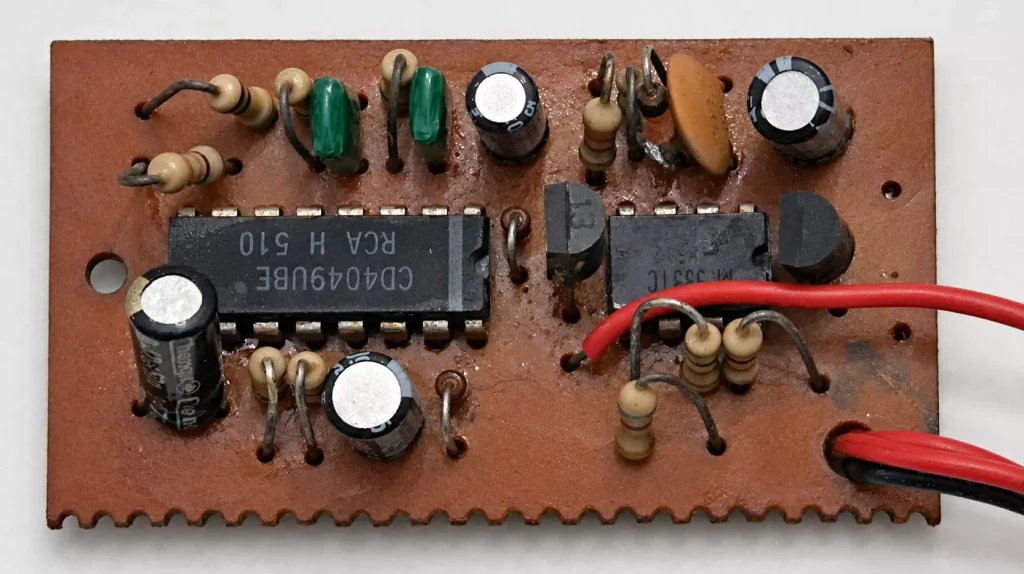
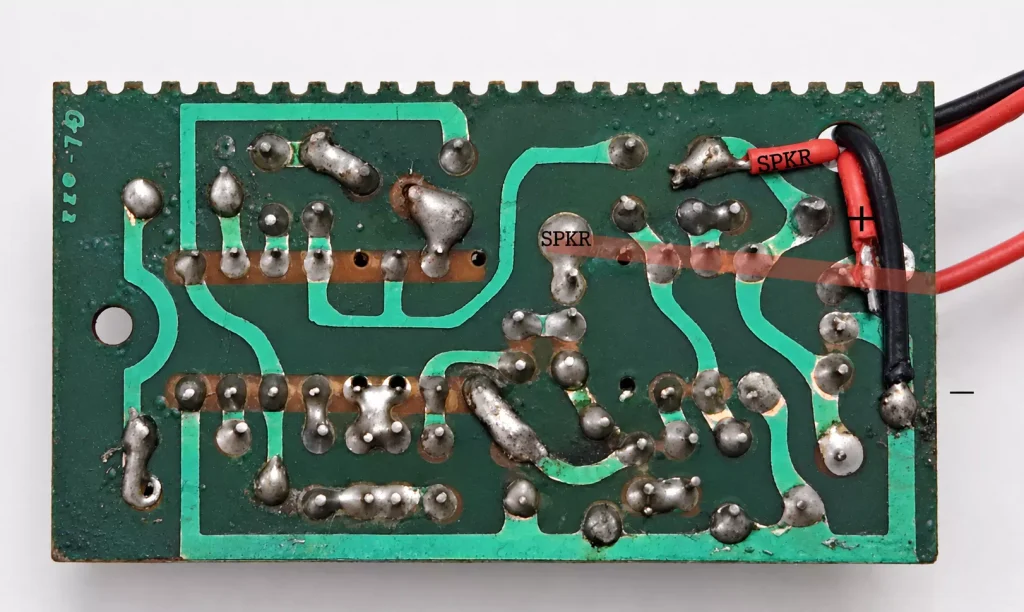
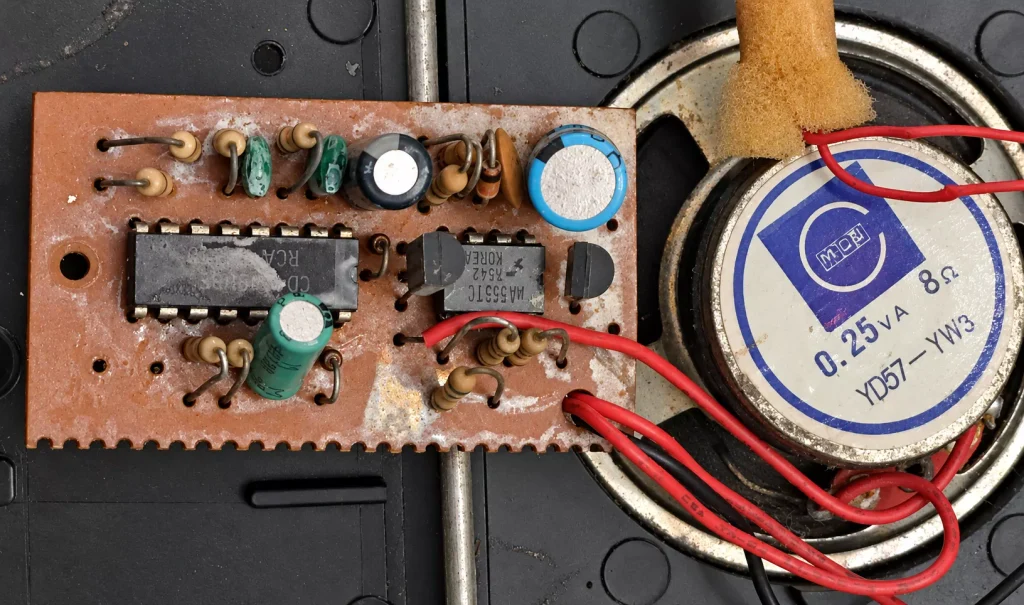
ChatGPT was able to partially decipher the circuit diagram. The CD4049’s inverters form two slow RC oscillators and one fast one. The LFOs can run from a few tenths of a hertz up to a few hertz, which is what the larger electrolytic capacitors and the film capacitors are for. The third oscillator probably runs in the kHz range and produces the fundamental tone. The oscillator outputs are mixed through diodes, and the TO-92 transistor amplifies the result to drive the speaker. The other TO-92 package is a voltage regulator, possibly a 78L05. The CD4049 is powered from pin 3 (the output) of the NE555, which is wired as an astable multivibrator, so the sound plays intermittently, with pauses in between.
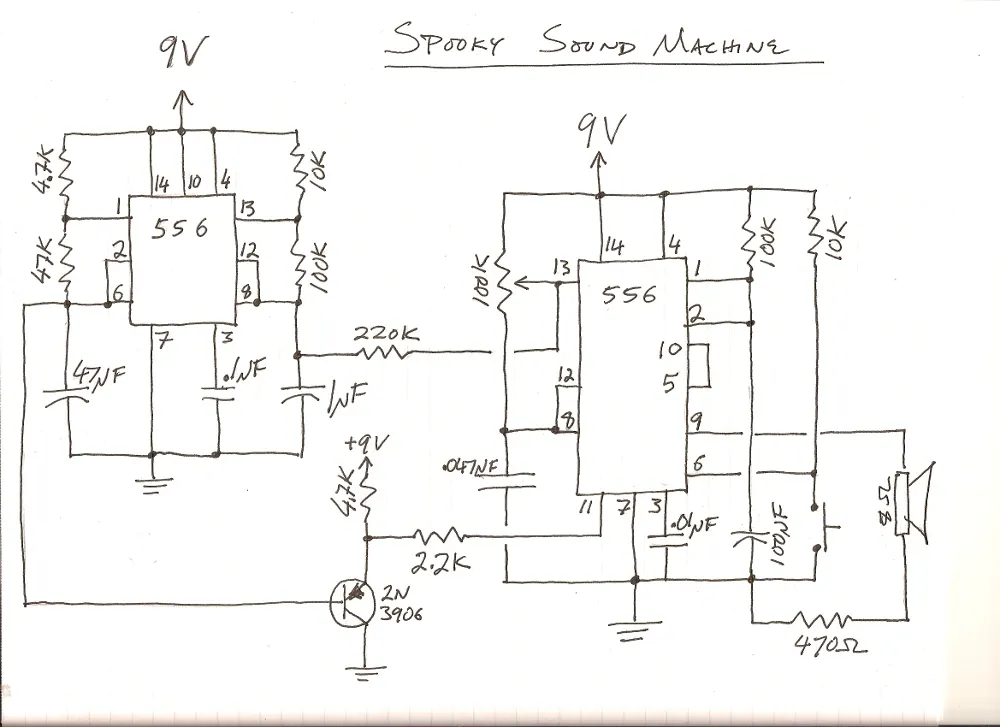
A circuit called “Spooky Sounds With 555 Timer” appeared on instructables.com in 2010, courtesy of Rachels Instructs. Joel produced the ghost sound with two NE556 ICs. An NE556 is essentially two NE555 timers in a single package. The circuit combines four timer wired in astable and monostable configurations. The key idea is that the threshold and trigger pins of one timer connect to the control voltage pin of a second timer to sweep frequencies up and down, creating a wailing or ghost-like pitch shift. Tying the output of the modulator timer to the discharge pin of the audio generator produces tone modulation and a shaky vibrato effect.
My circuit was simple: just a few BC108 transistors. If I remember rightly, it was originally meant to be a doorbell imitating birdsong, but it didn’t quite work out, and it turned into a ghost instead. Shame it got lost…
These days it’s not worth bothering with analogue solutions. The simplest way to produce ghost sounds is a push-button-triggered MP3 player module. You can get various kinds for €2–15. Some can only play back a recorded sound, others are programmable via USB, and some even have an SD card slot and LiPo battery charging/protection circuitry. Instead of a push button, you can trigger playback with a PIR motion sensor module.

The DY-HV20T is a ready-made sound playback board. You copy your ghost sounds onto a micro SD card, connect a suitable speaker, and the module plays the files. It can run on its own, without a microcontroller: playback is started by applying digital signals to its IO pins, so a simple switch is enough to trigger it. It needs a supply of 6–35 V, and its built-in 20 W Class D amplifier can drive a 4 Ω speaker at 20 W or an 8 Ω speaker at 10 W directly, which is plenty for a pumpkin by the garden fence.
In practice: record or download a few spooky sounds as MP3 or WAV files, copy them onto the card, and set the module to IO trigger mode with its DIP switches. Each of the IO0–IO7 inputs triggers its own sound file when pulled low. A push button between an IO pin and GND is the simplest trigger. For a proper scare, use a PIR motion sensor module instead, so the pumpkin starts wailing as soon as someone walks past. One catch: the common PIR modules give an active-high output, so you’ll need a small NPN transistor to pull the IO input low. The module also has a BUSY output that stays low while a track is playing and goes high (3.3 V) when it finishes. You can use it to switch the lighting effect, so the pumpkin lights up only while it’s “talking”.
The lighting effect can be a plain LED, a flashing LED, or even high-brightness LEDs driven by an Arduino. If you don’t want to go to much trouble, you can get a very striking effect with a leftover length of RGB LED strip and a matching controller.
A haunting in the garden
As I said, back then all I had was an ordinary incandescent bulb, painted green, whose brightness could be adjusted by hand with a 47-ohm wirewound potentiometer. The sound came from a pocket-radio speaker. The installation went ahead: pumpkin on the fence by the snowberry bush, twin-lead run into the room where I was supposed to be sleeping. There was just one flaw: in my calculations. I hadn’t reckoned on this pumpkin having a completely different effect on Mári! A candle-lit pumpkin flickers steadily with a faint, yellowish light, which surprises no one. My pumpkin, though, suddenly lit up bright green and started shrieking.
The outcome isn’t hard to guess: once again there was running, shrieking and screeching:
“Muramista! Pista Mürkli’s come back outta th’ grave!”
And the pumpkin didn’t even look like old Uncle Pista Mürkli. Uncle Pista’s head wasn’t striped…