Kite flying is one of those rare pleasures that works equally well for children, grandparents and everyone in between. At its simplest it is a bright toy tugging at a line in the wind; at its best it becomes a quiet lesson in balance, air, tension and patience. And with competition kites — stunt kites, fighting kites, high-performance deltas and large display kites — it is not merely a pastime but a genuine sport of skill, timing and fine control.
The history of kites reaches back to antiquity. Bodóczky István’s Sárkányépítés presents the kite as one of humankind’s earliest successful flying structures: a heavier-than-air object that could rise not by magic, but by aerodynamic force. The book traces the earliest written and visual evidence mainly to China, where kites were used not only as toys or ritual objects, but also for military signalling, measuring distances, frightening enemies and experimenting with the principles of flight.
From East Asia the kite spread across Japan, Korea, Southeast Asia and the Pacific, where it acquired local forms, materials and symbolic meanings. In Japan, particular towns developed characteristic kite shapes and decorations; in some traditions, large kites were flown in festivals or even used in daring human-lifting experiments. In Europe, kites became more widely known from the Middle Ages onward, and by the 18th and 19th centuries they were also scientific instruments. They helped researchers explore electricity, meteorology and aerodynamics, and they formed part of the long prehistory of powered flight. By the 20th century, their role had shifted increasingly toward education, sport, recreation and artistic construction.
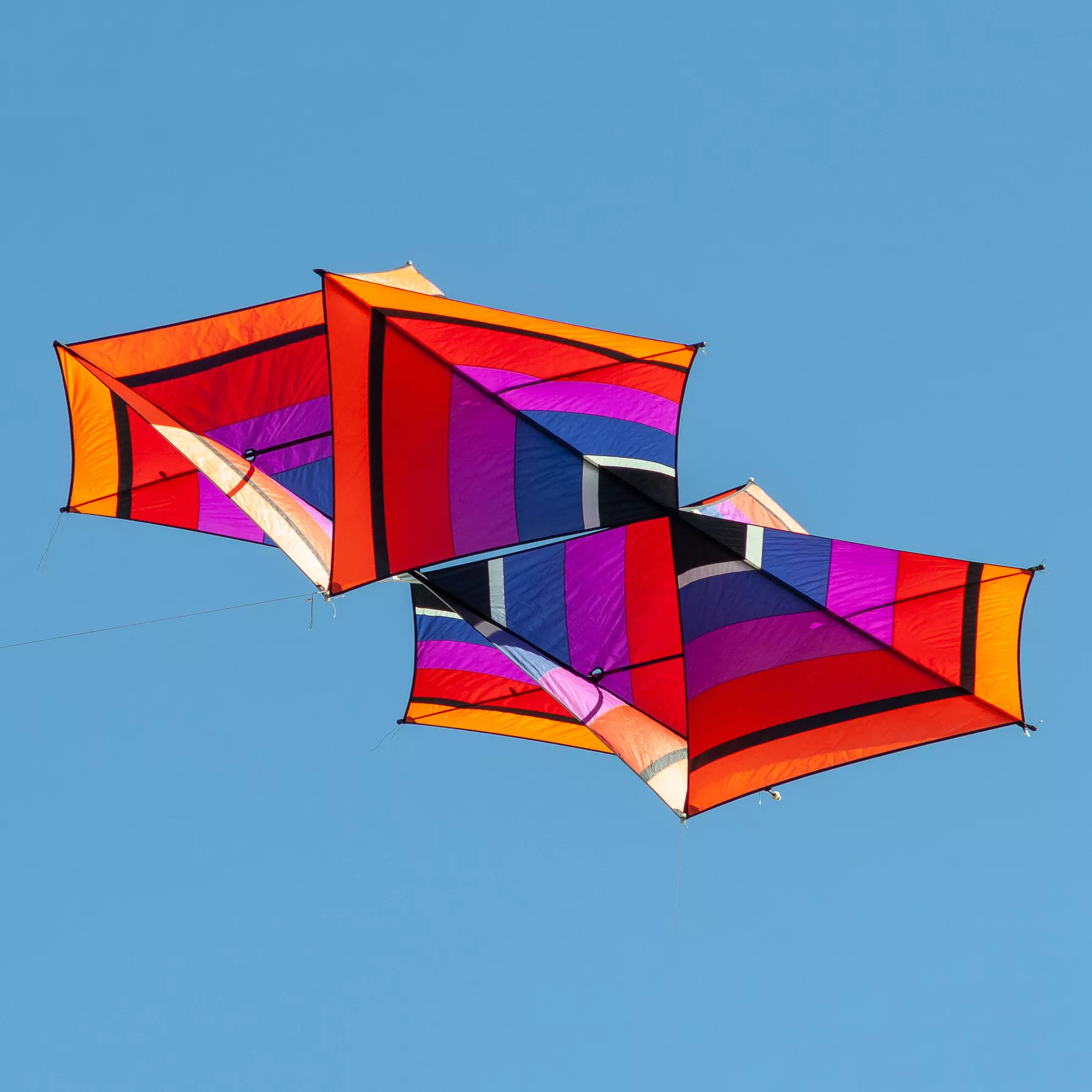
Kites can be grouped in several ways. The simplest are flat single-line kites: diamond, hexagonal, bird-shaped or traditional Asian forms, often stabilised by a tail or by their own bowed frame. Box and cellular kites, made famous by Lawrence Hargrave and later experimenters, use three-dimensional structure to gain stability and lift. Delta and Rogallo-type kites exploit flexible or semi-flexible wings; parafoils dispense with rigid spars altogether and take shape from the pressure of the wind. Sport kites, usually flown with two or four lines, are steerable and allow loops, dives, stalls and choreographed team flying.
Bodóczky’s book is especially valuable because it does not treat kites merely as shop-bought toys. It explains the basic theory — lift, drag, angle of attack, stability, weight and bridle adjustment — and then leads the reader toward construction. Its table of contents ranges from the history of flying kites and basic aerodynamics to practical chapters on flying, materials, paper kites, textile kites and a wide catalogue of historical and international kite types. For a Hungarian reader who wants to build a kite rather than simply buy one, Sárkányépítés remains an excellent starting point.
The book appeared in 1982, and the available materials have changed considerably since then. Builders today can use light carbon-fibre spars, fibreglass rods, ripstop nylon, polyester sailcloth, modern adhesives and strong synthetic flying lines. At the same time, Asian manufacturers have flooded the market with inexpensive, colourful and surprisingly well-flying kites. For a beginner, buying a ready-made kite is often easier and more reliable. But the magic of making one’s own flying object — cutting the sail, setting the frame, adjusting the bridle, and watching it finally climb — has not disappeared.
Nor should one forget that a kite, whether bought or handmade, still has to be flown properly. Many beginners make the classic mistake of trying to run with the kite, which may work in cartoons but is wrong in real life. If the launching technique, wind direction, line handling or bridle adjustment is poor, even a good kite can become a disappointment. Bodóczky’s book is useful in this respect as well: besides construction, it also teaches the practical basics of choosing the right conditions, launching, controlling and troubleshooting a kite.
A beginning kite flyer should start with a simple, medium-sized kite. Large kites — roughly 1.5–2 metres across or larger — can generate enormous force in the wind, which may become dangerous. Very small kites — about 0.5 metres or less — are often difficult to fly: they are sensitive to turbulence and tend to be less stable. For a first attempt, even a traditional deltoid kite will do, with a reed frame and a tracing-paper sail. It can be made in half an hour, but it needs a long tail; otherwise it will not be stable. Simple three-dimensional box kites can be flown in a much wider range of wind speeds and are far more stable. So if a beginner decides to buy a kite, this is the kind worth starting with — not a complicated, decorative model shaped like an animal or a fighter jet.
Bodóczky István was a Hungarian visual artist, teacher, constructor and writer. He was born in Szolnok in 1943 and died in Budapest in 2020; he studied at the Hungarian University of Fine Arts, later taught visual art, and received the Munkácsy Mihály Prize in 1989. His work increasingly joined painting, lightweight construction and flight: from the 1970s he began making his own string kites, and from the 1980s he brought together painting and kite-like spatial structures. His 1982 book Sárkányépítés is listed among his publications. (Wikipédia)
Bodóczky’s favourite saying captures the spirit of the whole subject: “Mindent lehet reptetni, ez csak kantározás kérdése” — “Anything can be made to fly; it is only a question of bridling.” It is a technical joke, but also a small philosophy of making: if the balance is right, even an unlikely object may find its place in the wind.


