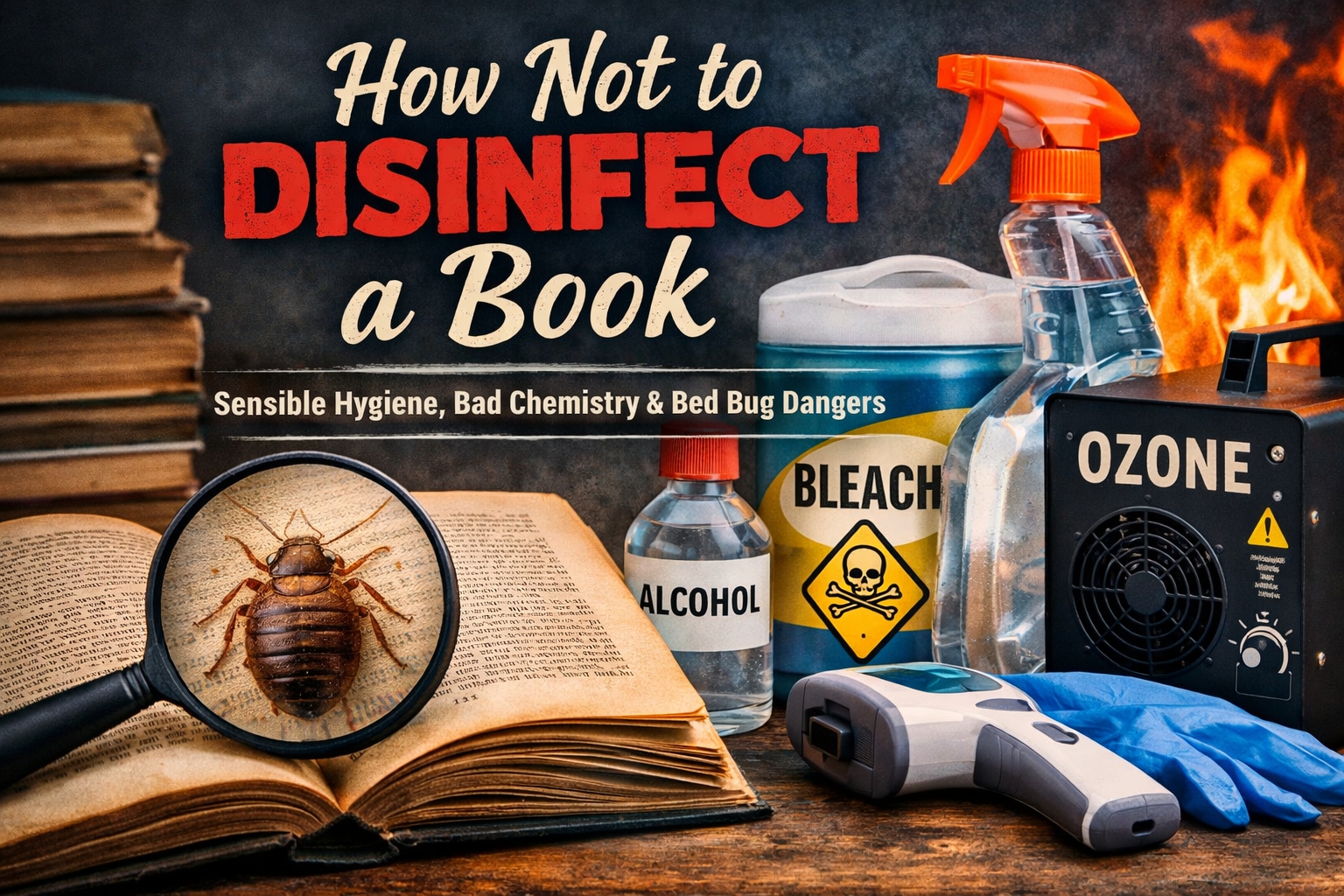
Used books do not need sterilizing, but they do need sensible handling. Since the COVID years, no shortage of dubious “disinfection” methods has appeared, from alcohol sprays to ozone generators—many of them more dangerous to paper than to microbes. In practice, the only truly serious risk is not infection, but the chance of bringing home a bed bug with the book.
Some people recommended ethyl alcohol, which is not a good idea because it can dissolve certain printing inks. As a general rule, books should not be treated with any liquid disinfectant, because it does them no good. Besides, ethyl alcohol is only a satisfactory disinfectant if it is at least 70% strength. If you buy something like this, read the composition, because even now there are several lower-alcohol products on the market that are ineffective. Pálinka or vodka as a disinfectant is a nonstarter for anything. Below 50% ethanol content—that is, if water is the dominant component—it is essentially ineffective. My own recipe:
50 parts 98% ethyl alcohol,
20 parts 99.8% isopropyl alcohol,
3 parts 3% hydrogen peroxide solution,
1 part glycerin,
10 parts distilled water.
The ingredients can also be bought in pharmacies, but glycerin and hydrogen peroxide (as hair bleach) are also available in some drugstores and hairdressing supply shops. If distilled water is not available, tap water boiled for 15 minutes and then cooled is also suitable. Pour the resulting mixture into small bottles, say 100 ml each, and store them in a cool place before use. It can be used for hand disinfection and for disinfecting objects as well.
INNOCID instrument and surface disinfectant solution is very effective; it is also sold in spray bottles at a 3% dilution. Contact time: 3 minutes for bactericidal activity (including MRSA), fungicidal activity, and selective virucidal activity (against enveloped viruses), and 15 minutes for tuberculocidal activity. The problem with it is that, because of its relatively high isopropyl alcohol content, it dissolves printing inks, especially blue inks, so it is not suitable for treating books, boxes, and similar items. In larger amounts it can also leave a brownish mark. INNO-SEPT, which is likewise economical in one-litre packaging, is less aggressive toward printed products because of its lower isopropyl alcohol content. It also contains surfactants, so if necessary it can be used to clean soiled book covers.
It is worth mentioning that for household purposes one of the best disinfectants is the aqueous solution of sodium hypochlorite: bleach. Household bleach is typically a 5% sodium hypochlorite solution, which, when diluted 1:10 to 1:100, is a suitable disinfectant: bactericidal, sporicidal, virucidal, and ovicidal against worm eggs, though it does not work against some fungi. Its action is highly complex: it forms chloramines with the amino groups of proteins, oxidizes enzymes, breaks DNA into pieces, disrupts the metabolism of living microbes, causes nutrient and oxygen deficiency, and inhibits protein synthesis. In short, it destroys the organic matter it comes into contact with within minutes. It can also be used to disinfect drinking water, to wash a dog’s or cat’s bowl, and for mold removal.
Bleach is easy to obtain, cheap, and effective, but there is no point in stockpiling it. During storage, the active chlorine content of the solution decreases over time, and after a few months it is hardly worth anything. Do not use bleach that is three months old; pour it out instead (straight into the drain is fine, it is not environmentally hazardous). For the same reason, bleach should be diluted with cold water; in hot water the chlorine escapes and the solution will not be effective. It is useful to know that several extremely expensive mold removers are in fact nothing more than diluted bleach sold in colorful bottles at a high price. Domestos is also bleach, but in addition to sodium hypochlorite it contains a surfactant (detergent). That makes it clean better and gives it grease-cutting power as well (which plain bleach does not have), but it is this that makes it truly harmful. Although household bleach is marked in large letters as POISON (and it is!), in high dilution it is harmless. If a little remains in drinking water or in the cat’s bowl, that will not cause any trouble. Aquarium equipment can also be disinfected with it without hesitation if necessary, whereas Domestos must not be used, because any residual detergent can do nasty things in an aquarium.
Of course, bleach must also be handled carefully, because if other organic matter is present in the water (for example humic and lignin compounds of plant origin), it can also form dangerous, carcinogenic trihalomethanes and chloramines from them.
Unlike hypochlorite solution, the crystalline “pool chlorine” used to disinfect swimming pool water can be stored well. This is sodium dichloroisocyanurate dihydrate. When dissolved in water, it yields active chlorine, just like bleach. Although products sold in shops often mention only algicidal and bactericidal effects, studies show that with 10 to 20 minutes of exposure it also has adequate virucidal activity.
Both bleach and pool chlorine must never be mixed with other chemicals. Under the influence of acids, toxic chlorine gas is released from them, and inhaling it can be fatal. Neither is suitable for disinfecting books, because they oxidize the paper, which then yellows, becomes brittle over time, and crumbles apart. (They are suitable for removing stamp ink, however, but afterward the paper must be thoroughly washed with a dilute citric acid solution and then with water.)
In fact, there is no sensible reason to disinfect used books, because most microbes cannot survive for long without food and water. If you keep a book in a very dry place for a week, 99.9% of the microbes will die. Besides, these are for the most part microbes that are present in our environment anyway; we encounter them every day in the city, on the street, on the tram, in restaurants, and so on.
If the book is moldy, or if its cover is dirty, then wiping it with the above solution (or with 70% alcohol) helps. Do not soak the book. Use a paper towel or a microfiber cloth moistened with the agent, and only briefly. Factory pre-moistened wipes may also be good, but in some of them the disinfectant contains a high proportion of isopropyl alcohol, which dissolves printing ink, so it is worth testing them first on something expendable, such as a colored flyer.
There is only one sensible target when treating used books: the bed bug. You can bring it home not only from a hotel in your luggage, or from a train on your clothes, but also in used books. In the old days, when exchanging cassette tapes was fashionable, they spread with cassettes too. It is enough to carry home a single fertilized female, and then the trouble has already begun. To make matters worse, they are not easy to spot, because they can hide extremely well in the spine of a book.
The nymphs that hatch from the eggs are 1 mm or larger, and they usually develop fully in about six weeks, molting five times during that period. The adults are round, flat, brown animals 5–7 mm long. The surest evidence of their presence is the shed skins near the places where they live. Bed bugs typically live in the bed itself (the bed frame, the mattress), in its cracks and crevices, or close to the bed, because that is where the food is nearby—the human being. They feed at night, while people are sleeping, and their presence is often almost unnoticeable. They are rarely found more than 2–3 meters from the bed. They remain permanently only in places where they can also feed. Bed bugs emit pheromones, which is why a strong infestation is accompanied by a characteristic musty smell.
Bed bugs are very resistant. They survive in the cold; freezing does not help. Ozone generators are humbug as well; they are not bothered by them at all. Ozone is extremely reactive, and it is capable of destroying microorganisms that chlorine cannot neutralize effectively (for example Cryptosporidium). It is a gas that dissolves poorly in water and is highly explosive, so it cannot be stored or transported; that is why it has to be generated on site. It is used, for example, in drinking water treatment, for removing tastes, odors, and colorants, iron and manganese, and micropollutants, for algae removal, and for disinfection in surface waters—so the method does work, but anyone who knows the concentrations required also knows that disinfecting the interior of vehicles or apartments with an ozone generator is nonsense. Ozone is a non-selective, aggressive oxidizing agent: it attacks everything it touches. The concentration of ozone in the air that would be capable of killing bed bugs, microbes, and so on in hidden corners would be so high that it would slaughter houseplants, pulverize upholstery, and set the bookcase on fire. Precisely because paper—if it does not actually catch fire—crumbles apart from it, ozone cannot be used to disinfect books. You can buy a Chinese ozone generator that produces so little ozone that it does not ruin the paper, but then it is worthless and ineffective.
Most freely available insecticides sold in shops (for example synthetic pyrethroids) are not effective against bed bugs either, so even if you buy some bio-easy-DIY-unicide in the home improvement store, you might as well rub it into your hair. It is probably fine for head lice. These insecticides mostly contain pyrethrin, a neurotoxin produced by certain chrysanthemum species; it was already used as an insecticide in antiquity. On an industrial scale it is extracted from the flowers of the Dalmatian chrysanthemum (Chrysanthemum cinerariifolium), which is grown mainly in Kenya at altitudes of 1500–3000 meters (because that is where it contains the most pyrethrin), or in Croatia, or in Japan.
Besides natural pyrethrin, many kinds of synthetic pyrethroids are also on the market. Their molecules have different structural formulas; they differ from one another by an ester or ether bond, by a side chain, or by a functional group—differences that may seem insignificant, yet can cause very large differences in the effect of the compound. Every pyrethroid is both a contact poison and a stomach poison, and every one of them blocks the sodium ion channels of nerve cells, thereby preventing the propagation of nerve impulses. Because of the disturbance that sets in within the nervous system, they have a stunning effect, but death itself is caused indirectly, by paralysis and by the cessation of breathing and/or circulation. They are generally UV-sensitive; in sunlight the cyclopropyl part of the molecule breaks down, and within 24 hours the substance loses its effect.
According to several studies, bed bugs have developed resistance to most pyrethroid insecticides. The Protect bed bug and flea killer (Bábolna Bio) is said to be effective against Hungarian populations. This is also a pyrethrin-containing product, but it also contains piperonyl butoxide as an adjuvant, and S-methoprene, a growth-regulating hormone that disrupts insect development and prevents the insect from reaching the adult stage.
WARNING! Every pyrethrin-type product is dangerous to all insects, and to fish as well. Bees are especially sensitive to them. In cats these agents can also cause muscle tremors lasting several days and excessive salivation, which may be accompanied by vomiting, loss of consciousness, and even death. Therefore such products should not be used in a home with cats, or at the very least great care must be taken to ensure that not even a tiny amount gets onto the cat. I do not know how that can be ensured; best if the cat is not there at all. If some does get on the animal, it must be washed off immediately and thoroughly with soapy water, and then one must rush to the veterinarian. There is no antidote; treatment is only symptomatic, though there is a good chance the cat can be saved—but that also depends on how quickly the owner reacts.
For de-bugging books, the best method is heat treatment. If you put the book into a microwave oven for 1.5 minutes at approximately 700–1100 W, that is more than enough. According to scientific experiments on the subject, half of bed bug eggs (LT50) die after only 25 seconds of microwaving, and half of the adults in approximately 15 seconds, but in a paper book complete destruction requires 1 to 1.5 minutes. The young nymphs before their first molt withstand it best; for them LT50 is 44 seconds. The limit to the method is that after 1.5 minutes the book itself also begins to suffer damage. This microwave technique must be used immediately, as soon as you bring the book home. Otherwise, any bed bug hiding in the spine may crawl out and look for some nice hiding place. The problem is that there must not be any metal in the book, because metal parts can spark and the book may even burn. The basic rule is that no metal object whatsoever (spoon, fork, metal container, aluminum foil, plates coated with metallic paint, etc.) should ever be placed in a microwave oven, because this can damage the oven and/or the metal object.
Most microbes die off on their own if a book is kept dry and left alone, while harsh chemicals, bleach, and ozone are far more likely to damage paper than to solve any real problem. The sensible rule is simple: do not disinfect books unless there is a clear reason, clean covers gently when needed, and reserve serious action for the one threat that truly matters—the bed bug. A little patience, and a little chemistry, go much further than hysteria.