
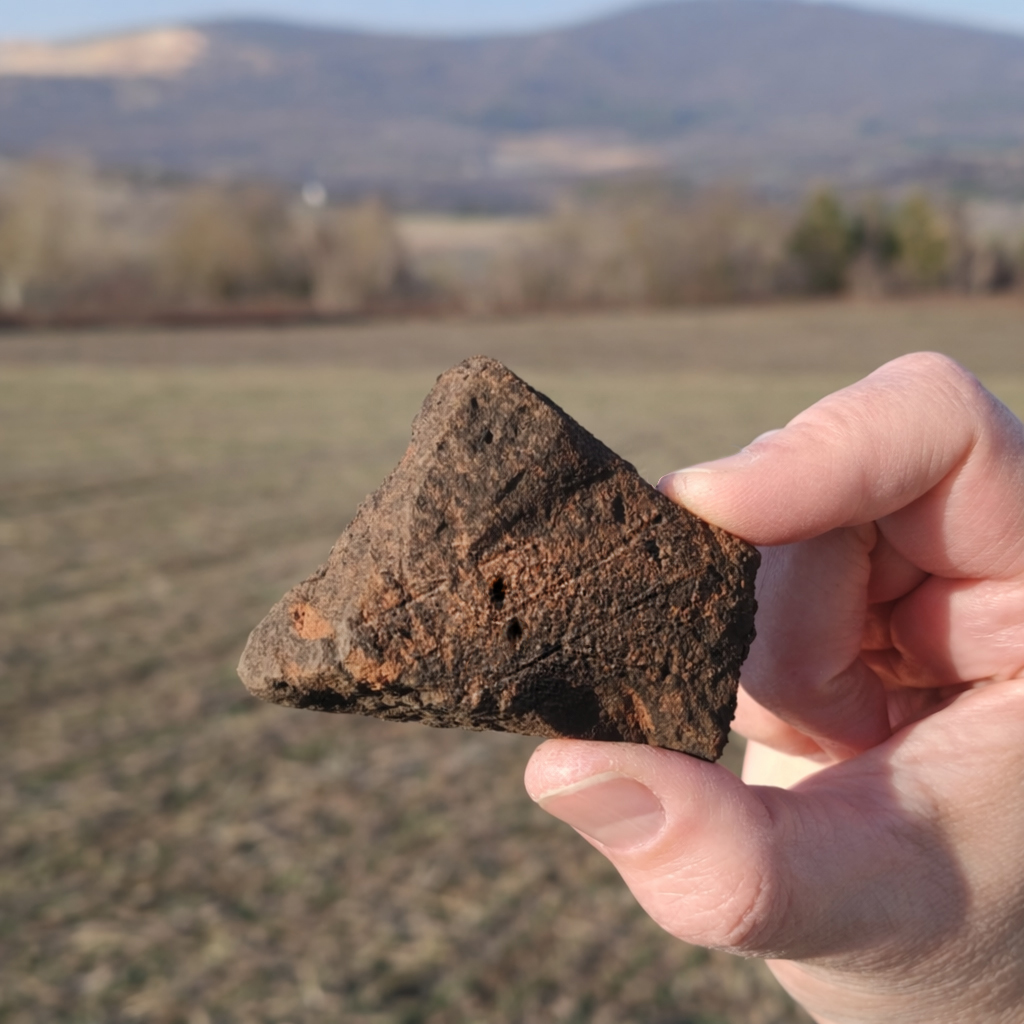
On the edge of the Danube Bend, near Vác, there is a place where history doesn’t live behind museum glass—it sometimes lies right in front of your boots. The Vác–Cigány Valley archaeological site, based on field surveys, shows settlement traces from the Middle Neolithic and the Late Copper Age—and what is most striking for a walker is this: after ploughing, fragments of pottery and knapped stone can appear on the surface.
This walk is not “treasure hunting”. It’s more like doing microscopy outdoors: you pay attention, you interpret, and you let the landscape tell you what life was like here thousands of years ago.
The site
Cigány Valley is a typical green fringe of the town: a pronounced valley, gardens, and arable fields up on the ridge. Fresh ploughing often turns up archaeological material here, and the area’s birdlife is also worth watching. Many people walk their dogs along these tracks—few realize what the ground can quietly contain.
When is it worth going?
- Best after ploughing, before vegetation covers the field.
- After rain the contrast improves: pottery and stone “pop” visually, though mud makes walking harder.
How to look around
- Don’t rush. Surface archaeology is often “ten metres of nothing, then a 2×2 metre patch full of signals”.
- Scan the crests of the furrows and the sides of turned clods—that’s where the fresh fracture of knapped stone can catch the light.
What might you see in the ploughsoil?
1) Pottery sherds
Surface pottery fragments are usually small, but they can tell you a lot:
- The fracture surface is often grainy because of the fabric/temper.
- The colour may be brick-red, brownish, or grey—depending on firing conditions and the clay.
- The surface may be smoothed; decoration is rarer.
At Cigány Valley, published material includes pottery attributable to the Middle Neolithic—likely connected to later, characteristic phases of the Transdanubian Linear Pottery culture (LBK – Linearbandkeramik).
2) Knapped stone — blades, scrapers, drill tips, and “lithic industry waste”
Knapped stone does not always show up as an obvious “finished tool”. Often the most informative pieces are the core and the flakes:
- Core: the piece from which blades/flakes were struck.
- Flake and blade: sharp-edged removals; a blade is typically longer and more parallel-sided.
- Tools: scraper, a pointed piece with a drill-like role, perhaps a retouched edge.
Quick field tip
- Knapped stone often shows a conchoidal fracture and a bulb of percussion. Together, these two clues frequently tell you you’re not looking at an ordinary pebble.
The Note-head potter style
One well-known stylistic phase of the LBK in Hungarian archaeological writing is often referred to as “kottafejes” (“music-note-headed”) decoration. The name isn’t random: among the fine, orderly motifs of linear pottery there are sometimes dot-like, ‘head’ elements aligned along lines—features that, to modern eyes, genuinely resemble a musical score.
In terms of distribution, it occurs primarily in eastern Austria, the Czech Republic (e.g., Bohuslavice), Slovakia (e.g., Nitra/Nyitra), and Hungary; modified variants are also known from Germany, France, and Poland.
What’s worth knowing (in a hiker-friendly version)?
- It’s not a separate “people”, but rather a decorative style and chronological marker: it helps archaeologists place pottery in time and cultural context.
- The LBK world is part of the Neolithic transition in the Carpathian Basin: farming, animal husbandry, durable settlements, ceramic production—the toolkit of a settled life.
- Decoration in the Neolithic is not just ornament: it can function as identity, community signalling, and a shared visual language.
If you’re lucky, you may spot fine lines on a sherd in the furrows—rarely (this is real luck) even the “note-heads” themselves.
Ethics and law: looking is allowed, taking home is not
This is the most important part—and it’s not something to joke about.
In the field: document, don’t collect
On a walk you can observe surface finds, but you must not pick them up and take them away.
What to do instead
- Leave it where it is. That’s the baseline.
- If you already picked it up, put it back in the same spot, and:
- record the exact GPS coordinates,
- take a close-up photo of the object (ideally with some scale),
- take a wider photo of the surroundings so the location can be identified later.
Reporting duty: 48 hours
If someone finds an archaeological object, it must be reported without delay (no later than within 48 hours) to the competent county-scope city museum or to the municipal clerk (jegyző).
The legal background
In Hungary, the legal status of archaeological finds is regulated by strict rules. The key principle:
- All archaeological finds are the property of the Hungarian state.
- It does not matter whether you found it on your own land or lying on the surface of a ploughed field: the law does not distinguish between a “valuable gold hoard” and an “ordinary” pottery sherd.
- An archaeological find is any movable object that was created before 1711 and is recovered from the ground, the beds of waterways, or elsewhere.
This isn’t bureaucratic nit-picking: the value of a find is often precisely in where it was. If the context disappears (because you take the object with you), that is what gets lost.
The valley as a time window
Vác–Cigány Valley isn’t just a nice place for a walk. It’s a reminder that prehistory can be tangible: a pottery fragment, a blade, a core—and behind them, a community that lived here, worked, cooked, and made tools.
Go, look, document—and leave things in place. The best souvenir is not a pottery sherd in your pocket, but the realization that the landscape—if you pay attention—still speaks.